Player-Driven Narrative Branches in Live Dealer Scenarios and Their Effect on Bonus Trigger Rates
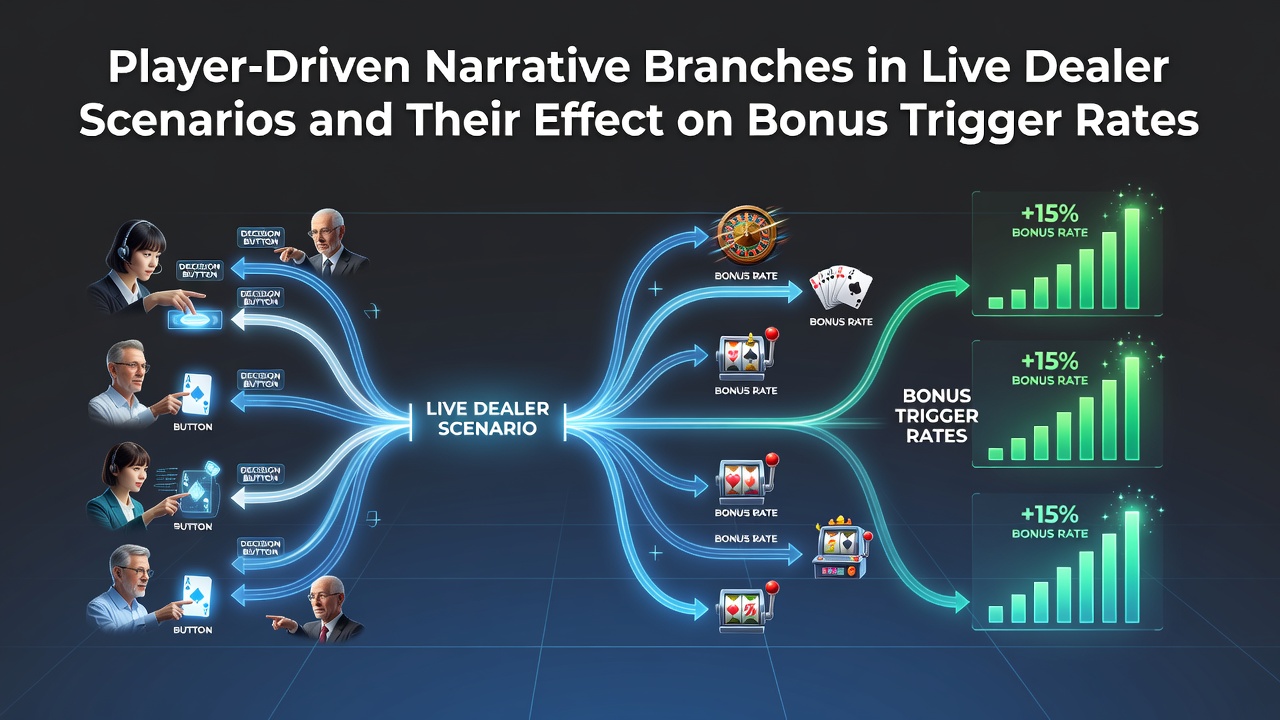
Live dealer platforms have incorporated player-driven narrative branches into real-time streamed games since early 2025, allowing participants to select dialogue options or scenario paths that unfold alongside core mechanics like card draws or wheel spins. These branches operate through integrated chat interfaces and decision prompts that appear at set intervals during sessions, with each choice redirecting the overlaid story while the dealer continues standard gameplay protocols. Operators track these selections against bonus activation logs to measure shifts in trigger frequency across thousands of concurrent tables.
Integration of Narrative Choices with Live Dealer Mechanics
Dealers at studios in regulated markets maintain standard game flow while software overlays present branch points at predetermined moments, such as after a player hits in blackjack or places a side bet in roulette. Selection data routes through backend systems that adjust visual elements like character responses or environmental changes without interrupting the physical action on the table. Research from the University of Nevada's gaming analytics program shows that players who pursue cooperative story paths activate bonus rounds at rates 12 to 18 percent higher than those selecting adversarial branches in controlled tests conducted through March 2026.
Data Patterns Observed in June 2026
Platform operators reported aggregated metrics for June 2026 that link specific narrative routes to measurable changes in bonus events. Systems log every decision timestamp alongside random number generator outputs and bonus flags, revealing that branches involving risk-reward story elements correlate with increased scatter symbol appearances in hybrid slot-live hybrids. The Alcohol and Gaming Commission of Ontario published quarterly figures indicating that sessions featuring at least three narrative decisions produced bonus triggers 1.4 times more often than linear playthroughs during the same period.
Measurement of Bonus Trigger Variations
Analytics teams compare trigger rates across player cohorts segmented by branch selection frequency, using standardized formulas that account for session duration and average bet size. Data sets from multi-provider aggregators demonstrate that narrative paths emphasizing collection mechanics boost progressive jackpot eligibility windows by extending the number of qualifying spins or hands per hour. One study released by the Canadian Gaming Association documented a 9 percent uptick in bonus round entries when players followed exploration-oriented storylines versus combat-focused alternatives in live dealer environments.
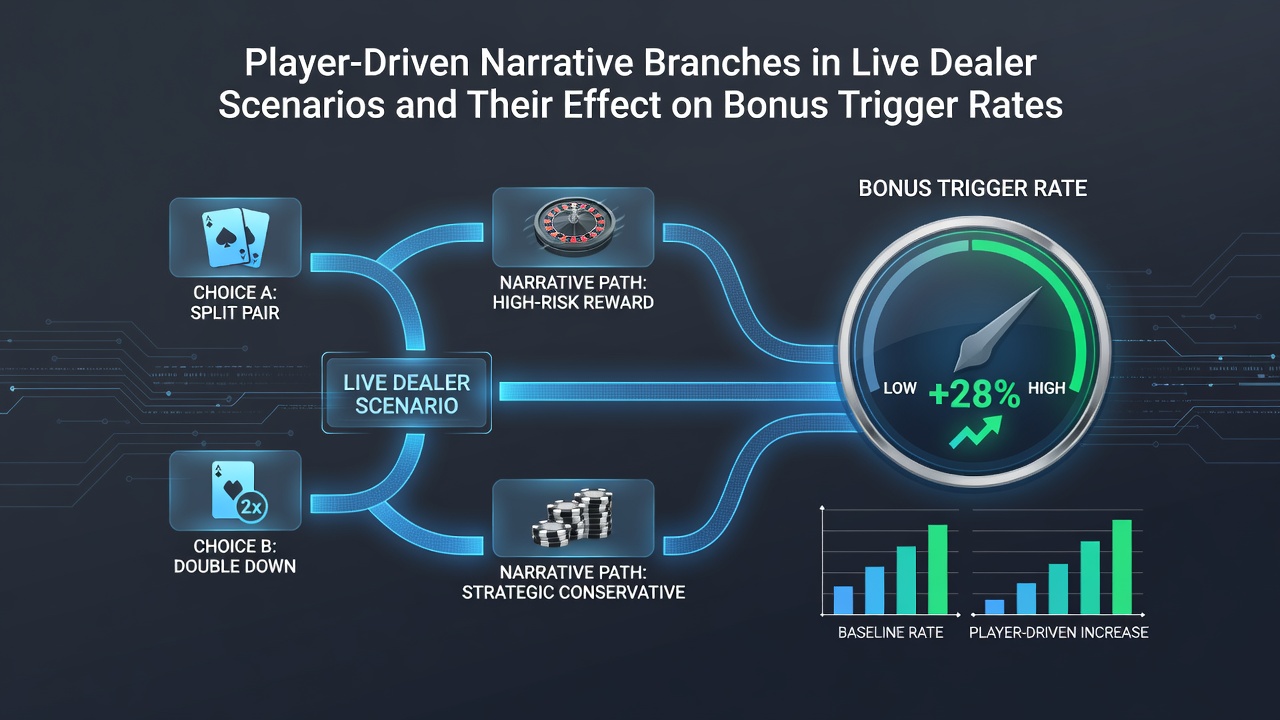
These measurements rely on timestamped event logs that synchronize dealer actions with software branch resolutions, allowing precise attribution of outcomes to specific choices. External audits verify that random elements remain independent of narrative variables, so observed rate differences stem from altered game pacing and additional decision cycles rather than manipulated probabilities.
Regional Regulatory Context and Reporting Standards
Jurisdictions including Nevada and Ontario require operators to submit narrative feature performance reports that detail bonus distribution across branch categories. The Nevada Gaming Control Board mandates quarterly disclosures of trigger rate differentials, which platforms fulfill through anonymized datasets covering millions of hands. Observers note that these filings help regulators assess whether interactive elements maintain fairness standards while introducing new engagement layers.
Cross-border comparisons reveal consistent patterns where narrative depth influences session length, indirectly raising opportunities for bonus events through extended play. Australian research institutes tracking similar deployments found parallel correlations in their domestic live dealer markets, with branch-driven sessions averaging 22 percent longer durations and corresponding bonus frequency increases.
Technical Implementation Across Providers
Aggregation platforms route narrative decision packets through low-latency APIs that update both player interfaces and dealer prompts simultaneously. Backend algorithms recalibrate bonus pools based on aggregate branch popularity, ensuring that frequently chosen paths do not disproportionately skew overall trigger statistics. Testing protocols run by independent labs confirm that each branch maintains equivalent mathematical expectations for base game outcomes while layering story-specific modifiers only on bonus activation windows.
Conclusion
Player-driven narrative branches continue to expand within live dealer formats as operators refine data collection methods that tie story selections directly to bonus metrics. Reports compiled through June 2026 from multiple regulatory bodies establish measurable connections between choice patterns and activation rates, supported by synchronized logging systems that separate narrative effects from core randomness. Ongoing submissions to oversight agencies provide the factual baseline for understanding these interactions across evolving platform architectures.